The Silent Architect Foundation is dedicated to strengthening the intellectual foundations upon which human learning is built. Its mission is to advance literacy, cognitive development, disciplined thought, and long-range intellectual growth through an educational architecture designed to clarify how the mind learns, organizes knowledge, and develops over time.
Modern education often concentrates on the delivery of information, yet meaningful learning depends on deeper conditions that make understanding possible in the first place. Attention, memory, language, structure, symbolic clarity, continuity, and reflective integration are not secondary concerns. They are the conditions under which knowledge can become stable, usable, and transferable. When those conditions are cultivated intentionally, students do not merely absorb content. They develop the ability to read deeply, think clearly, reason carefully, and engage the world with greater confidence, coherence, and intellectual steadiness.
Through research, pilot initiatives, and the development of intentionally ordered instructional systems, the Foundation works to cultivate intellectual acuity from early childhood through advanced study. Its purpose is not simply to add more content to already crowded learning environments, but to strengthen the underlying architecture through which learning becomes durable. In this view, educational renewal begins not with novelty for its own sake, but with a disciplined realignment between how minds actually grow and how schools are designed to teach.
At its core, the mission is simple: to strengthen the architecture of the human mind so that future generations inherit the tools necessary to understand, create, and lead. To fulfill this mission, the Foundation is advancing a comprehensive educational system centered on learning, comprehension, integration, and long-term intellectual development.
The Educational Vision
This body of work is designed to strengthen the underlying structures that support learning. Rather than focusing only on the transfer of content, it examines how knowledge is received, organized, interpreted, retained, connected, and applied within the developing mind. It is not a loose collection of ideas, but a dependency-aware educational architecture intended to reduce cognitive friction, strengthen coherence, and make understanding more stable across time.
Many school systems emphasize the accumulation of material. While content remains essential, intellectual growth also depends on the powers that allow information to be understood, integrated, remembered, and used with precision. Learning therefore cannot be reduced to exposure alone. It must also involve the cultivation of the internal and external conditions through which knowledge becomes meaningful, durable, and available for transfer.
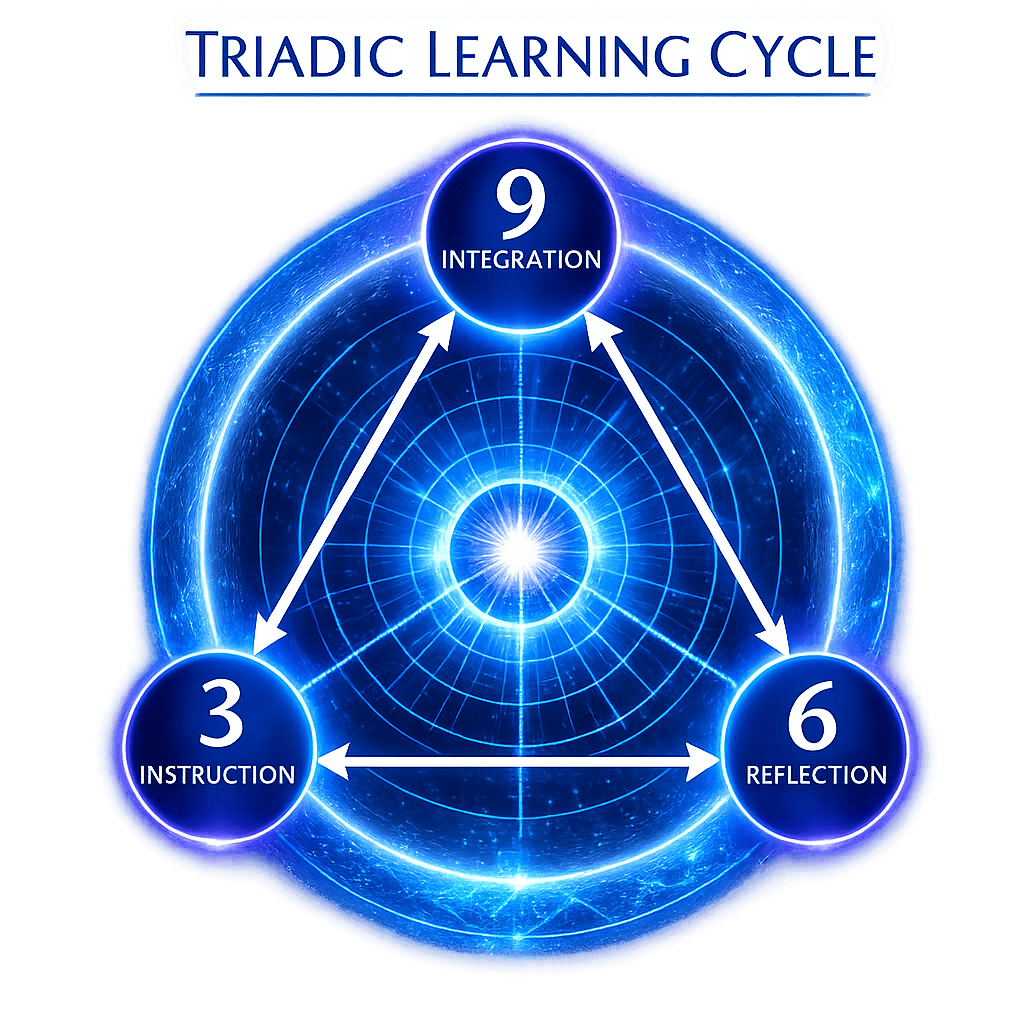
Within this architecture, learning is not treated as a simple sequence of lessons delivered in isolation. It is understood as the gradual formation of a durable internal order. Direct instruction provides sequence, clarity, and progression, while recurrence, reflection, and guided integration allow ideas to be revisited, examined from multiple perspectives, and consolidated more deeply over time. In this way, knowledge is not merely presented to the learner. It is progressively incorporated into a more coherent and usable structure of thought.
The architecture is organized around three central principles. The first is the Functional Dichotomy of Learning, which joins linear precision with spiral return. The second is the Nine Cognitive Vectors, which identify the principal dimensions of intellectual development. The third is the Centripetal Model of Cognitive Integration, which explains how scattered knowledge becomes ordered into coherent structures of meaning. Together, these three elements describe how learning begins, how it deepens, and how it becomes stable enough to support reasoning, transfer, and continuance across disciplines and across time.
This architecture may also be understood as a structured expansion. Foundational principles establish order, operational conditions shape the environment of learning, and multiple vectors of development strengthen the intellectual system until knowledge can be drawn inward toward integrated understanding. In this way, the framework is not only educational in intention, but architectural in design.
Structural Dynamics of Learning
This educational architecture treats learning as a developmental process rather than a simple act of information delivery. Many academic environments focus heavily on curriculum coverage, testing outcomes, benchmark performance, or short-term demonstration of skill, yet the deeper process by which understanding takes shape often receives far less attention. It is precisely that deeper process, however, that determines whether knowledge remains temporary and fragmented or becomes durable, connected, and intellectually useful.
A learner may be exposed to facts, vocabulary, explanations, and procedures without necessarily developing understanding. Information can be presented clearly and still fail to become meaningful if the learner lacks the structural support, symbolic clarity, or continuity required to connect it with prior knowledge. For this reason, learning must be understood not only as the reception of material, but as the cultivation of the conditions through which material can be transformed into comprehension. Stability, predictability, coherence, and reinforcement are not cosmetic features of schooling. They are part of cognition’s working environment.
This view also changes how educational difficulty is interpreted. When students struggle, the first question is not who failed, but what condition within the instructional environment, sequence, pacing, symbolic interface, or reinforcement cycle requires refinement. The burden of correction shifts away from blame and toward examining the design of the learning system itself. Confusion, hesitation, inconsistency, and breakdown are treated as informational signals that reveal where alignment, pacing, clarity, continuity, or support may need adjustment.
Under this philosophy, mistakes are not framed simply as errors to be punished or deficiencies to be stigmatized. They are treated as data points, reflection points, and diagnostic indicators within the broader educational process. A mistake may reveal a gap in sequencing, a missing conceptual bridge, a weakness in symbolic understanding, a lapse in attention, or insufficient consolidation across time. By interpreting mistakes in this way, education becomes more humane, more analytical, and more constructive. Correction becomes less about blame and more about refinement.
The deeper implication of this view is that schooling must be judged not only by what it presents, but by the conditions it creates. A structurally coherent learning environment reduces unnecessary friction, preserves continuity across time, stabilizes symbolic systems, and makes comprehension more likely. In such an environment, students are not forced to construct understanding under chaotic or fragmented conditions. The architecture itself carries part of the work. This is one of the foundation’s most important premises: the environment of learning is not incidental to cognition. It is one of cognitions’ active supports.
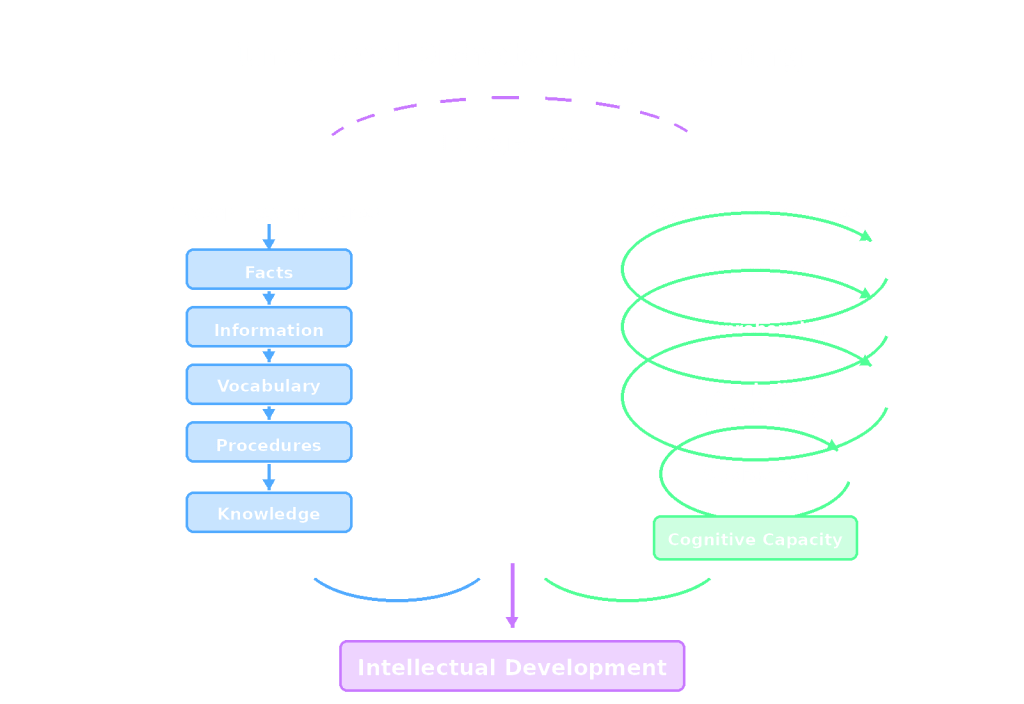
A central principle within this architecture is the Functional Dichotomy of Learning. This principle recognizes that durable understanding depends on the interaction of two complementary processes that must work together if education is to produce lasting comprehension.
The first process is linear precision. Learners are introduced to facts, vocabulary, concepts, and procedures in a deliberate sequence so that knowledge can accumulate in an orderly and accessible way. Clear progression reduces unnecessary cognitive friction, protects working memory from overload, and allows understanding to grow on stable foundations rather than on improvised guesswork.
The second process is spiral return. The mind does not develop understanding only by moving forward once through content. It returns to ideas through reflection, comparison, guided application, dialogue, and increasingly sophisticated encounters with the same underlying concepts. What first appears as repetition is often refinement. Concepts deepen when they are revisited under new conditions and reintegrated with prior understanding.
These two processes are distinct but inseparable. Linear sequence without recurrence produces shallow recall. Recurrence without structure produces drift. This architecture therefore joins ordered presentation with recursive deepening so that knowledge can progress without collapsing into either rote repetition or superficial acceleration.
The importance of this dichotomy is not merely instructional but structural. Linear precision establishes sequence, boundaries, and accessibility. Spiral return establishes depth, reinforcement, and conceptual widening. One provides order; the other provides deepening. One protects against disorder; the other protects against superficiality. When these two processes are joined deliberately, the learner is not forced to choose between clarity and complexity. Instead, understanding unfolds through both.
This is one of the architecture’s defining insights: educational strength emerges not from abandoning sequence in the name of innovation, nor from clinging to sequence without return, but from infusing ordered instruction with recursive deepening. In this way, the Functional Dichotomy of Learning becomes one of the primary engines through which knowledge moves toward durable understanding.
Caption:
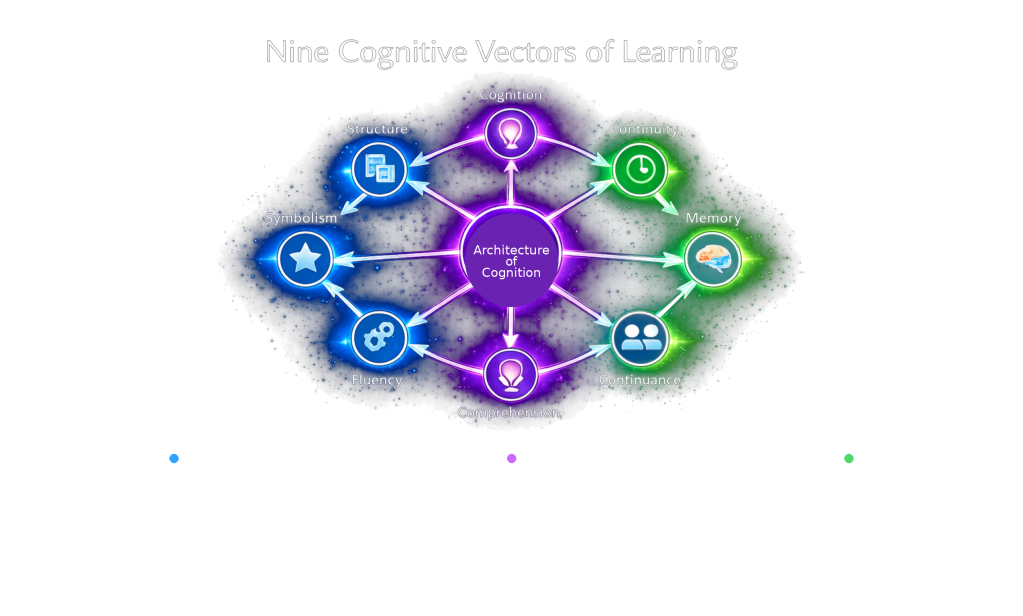
Intellectual growth does not unfold through a single mechanism. It develops through multiple interdependent dimensions that shape how learners receive, retain, organize, interpret, and apply knowledge. These dimensions function as vectors: directional forces that influence the strength, coherence, and durability of understanding. Each vector is distinct, yet all are structurally interdependent rather than isolated stages of instruction.
Vector I – Cognition
The core of the system: how understanding forms, stabilizes, and becomes available for use. This vector concerns the learner’s capacity to process relationships, build meaning, and convert exposure into durable comprehension.
Vector II – Structure
The design of schedules, routines, sequences, expectations, and instructional boundaries that reduce cognitive friction and make learning more coherent. Structure carries part of the work so understanding does not have to fight for every inch.
Vector III – Continuity
The preservation of connection across lessons, days, weeks, and domains. Continuity ensures that learning is cumulative rather than episodic, and that ideas reappear in ways that stabilize rather than fragment understanding.
Vector IV – Symbolism
The clarity and stability of representational systems such as language, mathematical notation, diagrams, and formal concepts. Symbolic stability reduces decoding friction and supports accurate work with abstraction.
Vector V – Memory
Schema formation, retrieval, and long-term consolidation. Memory is not treated as rote storage alone, but as the organized internal architecture that allows knowledge to be carried forward, related, and used.
Vector VI – Fluency
Automaticity that frees executive resources. When foundational processes become stable and efficient, attention is liberated for higher-order reasoning rather than consumed by basic decoding or procedural tracking.
Vector VII – Comprehension
Inference, evaluation, and epistemic judgment. Comprehension extends beyond recall into interpretation, disciplined meaning-making, and the ability to determine what something means, how it fits, and whether it holds.
Vector VIII – Integration
Cross-domain transfer and applied reasoning. Integration allows knowledge from one domain to inform understanding in another, making learning more flexible, relational, and useful in authentic contexts.
Vector IX – Continuance
Institutional resilience, ethical stewardship, and generational transfer. Continuance concerns the preservation, extension, and responsible transmission of knowledge so that learning does not end at the individual moment of acquisition.
These nine vectors form a unified developmental constellation. Each names a different dimension of growth, yet each also supports the others. Difficulty in one area often affects several others. For that reason, the vector system provides not only a language of strengths, but a more refined diagnostic language for understanding struggle without collapsing it into judgment.
The vector framework also reveals that cognition is not one thing. It is not a single faculty nor a simple score. It is a dynamic architecture built from interacting conditions and capacities that reinforce one another over time. Learning becomes more durable when structure supports continuity, when continuity supports memory, when memory supports fluency, when fluency supports comprehension, when comprehension supports integration, and when integration contributes to continuance. In that sense, the vectors are not merely descriptive categories. They form a map of how intellectual development becomes coherent.
Vectors Across Academic Disciplines
Learning does not develop along a single path. Intellectual growth occurs through multiple reinforcing dimensions that shape how individuals read, reason, interpret, and apply knowledge. Within the Architecture of Cognition framework, these dimensions are described as cognitive vectors—directional forces that strengthen the mental structures underlying comprehension, memory, analysis, and creative thought. When cultivated together, these vectors amplify learning across every academic discipline.
Because these nine vectors operate at the level of cognitive structure rather than individual subject matter, they strengthen learning across every academic discipline. Whether students are studying literature, mathematics, science, history, philosophy, economics, technology, or the arts, the same underlying vectors reinforce the learner’s ability to read deeply, reason clearly, recognize patterns, retain knowledge, and synthesize ideas.
In literature and language studies, literacy development, language and expression, and reflective comprehension deepen engagement with complex texts and ideas. Students become better able to interpret meaning, analyze structure, communicate insight, and engage language with greater precision and depth.
In mathematics, symbolic and conceptual understanding, reasoning, attention, and intellectual discipline strengthen the ability to work with abstraction, follow logical relationships, solve problems, and persist through difficulty with clarity and order.
In science, attention, curiosity, reasoning, memory integration, and conceptual understanding support observation, investigation, pattern recognition, evidence-based explanation, and disciplined interpretation of the natural world. Students learn not only to remember scientific knowledge, but to think scientifically.
In history and the social sciences, memory, reasoning, language, and reflection help students connect events, interpret causes and consequences, compare perspectives, and form more coherent understanding of human systems, institutions, and development across time.
In philosophy, civics, and economics, language, reasoning, reflection, and discipline support the examination of ideas, the weighing of evidence, the evaluation of systems, and the formation of thoughtful judgment. These vectors help students move beyond opinion into structured understanding.
In technology and engineering, symbolic understanding, analytical thought, memory integration, and disciplined sequencing support design, modeling, problem-solving, and the ability to work effectively within complex systems and procedural environments.
In the arts, symbolism, attention, reflection, and expressive fluency support interpretation, imagination, creative expression, and deeper appreciation of form, meaning, and aesthetic structure. Students learn not only to create, but to perceive with greater sensitivity and coherence.
Because these vectors strengthen the underlying architecture of learning itself, they do not belong to any one discipline alone. Their influence extends across the full educational experience. By cultivating them together, this approach seeks to develop learners who are not merely more informed in isolated subjects, but more capable of understanding, interpreting, and applying knowledge wherever they encounter it.
The Centripetal Model of Cognitive Integration
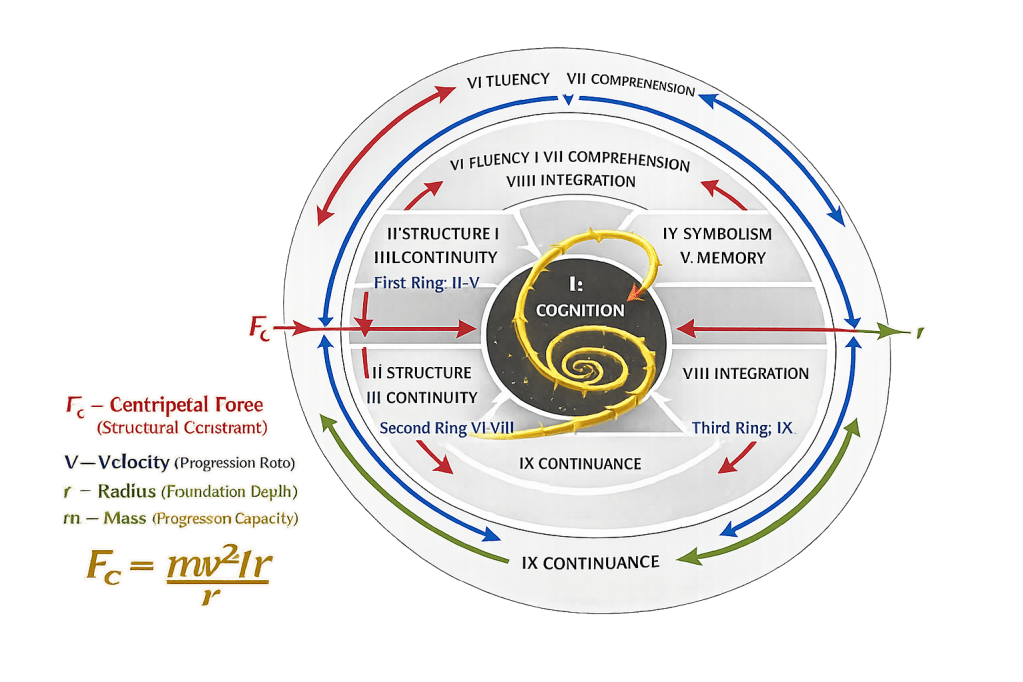
Caption:
Figure 3 The Centripetal Model of Cognitive Integration illustrates how knowledge is gradually drawn toward coherent centers of understanding through reflection, synthesis, and conceptual consolidation.
Another central principle within this body of work is the Centripetal Model of Cognitive Integration. This idea explains how learning deepens when ideas are gradually drawn toward coherent centers of understanding. The monograph represents this through constrained orbital motion: inward tension preserving coherence, progression advancing complexity, and cyclic return allowing understanding to deepen without disintegrating into shallow acceleration or collapsing into static repetition.
Applied to education, this means that knowledge should not merely accumulate outward as disconnected pieces. It should be drawn inward toward stable conceptual anchors. Through reading, reflection, comparison, dialogue, writing, and synthesis, learners begin to connect what once seemed separate. Information is no longer held only as isolated content. It becomes part of a wider structure in which relationships, patterns, and meanings become increasingly visible.
This principle also transforms the meaning of error. When a student produces an incomplete, fragmented, or misaligned response, the issue is not simply that something is wrong. It is that something has not yet cohered. A misconception may reveal disconnected knowledge, unstable symbolic grounding, overload, weak integration, or insufficient consolidation. In this way, mistakes become visible markers of where coherence is still developing. They help reveal not only what was missed, but what has not yet been fully connected.
The centripetal model therefore extends beyond metaphor. It provides a structural explanation of how knowledge becomes usable. Facts become understanding when they are gathered into meaningful patterns. Comprehension becomes more durable when ideas are drawn inward toward conceptual centers rather than left to drift as isolated fragments. In this way, the architecture treats integration not as an optional enrichment activity, but as one of the central processes through which learning becomes intellectually stable.
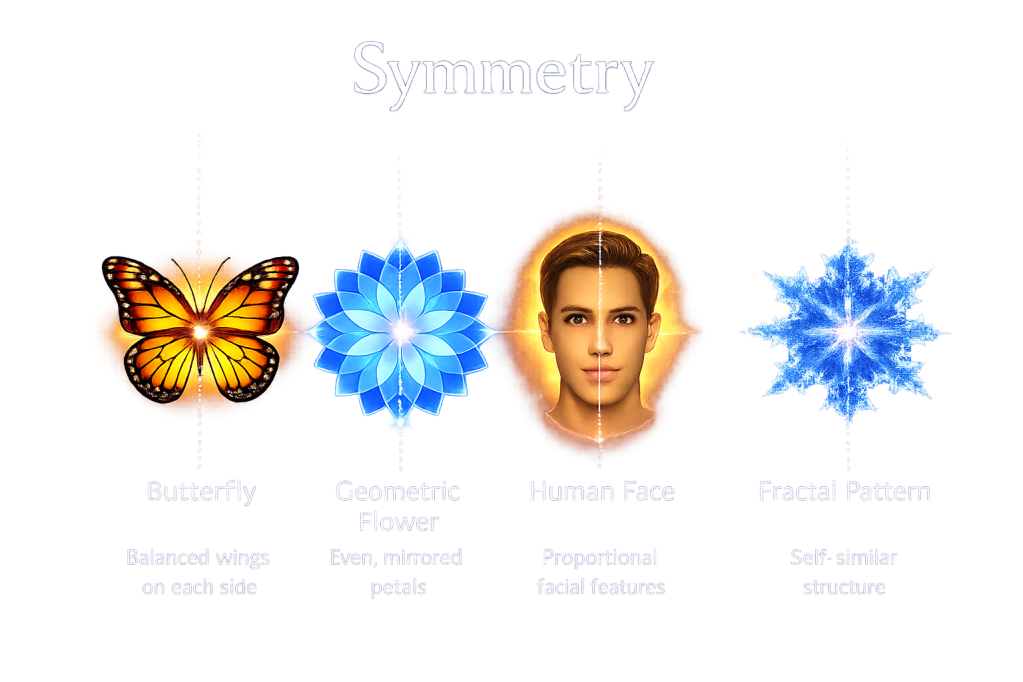
Caption:
Figure 4 — Structural symmetry within learning environments reflects the balanced organization of instructional relationships that support coherent intellectual development.
Symmetry represents structural order within the Architecture of Cognition. When instructional systems maintain consistent relationships between structure, continuity, symbolism, memory, fluency, and comprehension, learning develops with greater stability. Symmetry does not imply rigidity. Rather, it reflects the alignment of instructional architecture with the recurring patterns through which understanding forms and stabilizes.
Within this framework, symmetry signifies proportion, relation, and coherence. It is present whenever instructional design avoids arbitrary fragmentation and instead maintains balanced relationships between its parts. Predictable rhythms, stable symbolic systems, recurring conceptual anchors, and consistent reinforcement all contribute to structural symmetry. The learner is not forced to rebuild understanding from disorder at every stage. The architecture itself presents a recognizable order that cognition can inhabit and extend.
Symmetry also has diagnostic value. When understanding becomes erratic or fragmented, the question is not only whether the learner misunderstood, but whether the architecture lost proportion. A breakdown may indicate imbalance between sequence and return, between novelty and consolidation, or between symbolic demand and developmental readiness. For this reason, symmetry is not merely an aesthetic metaphor. It is a practical indicator of whether the instructional system is maintaining proportion across its own structural relationships.
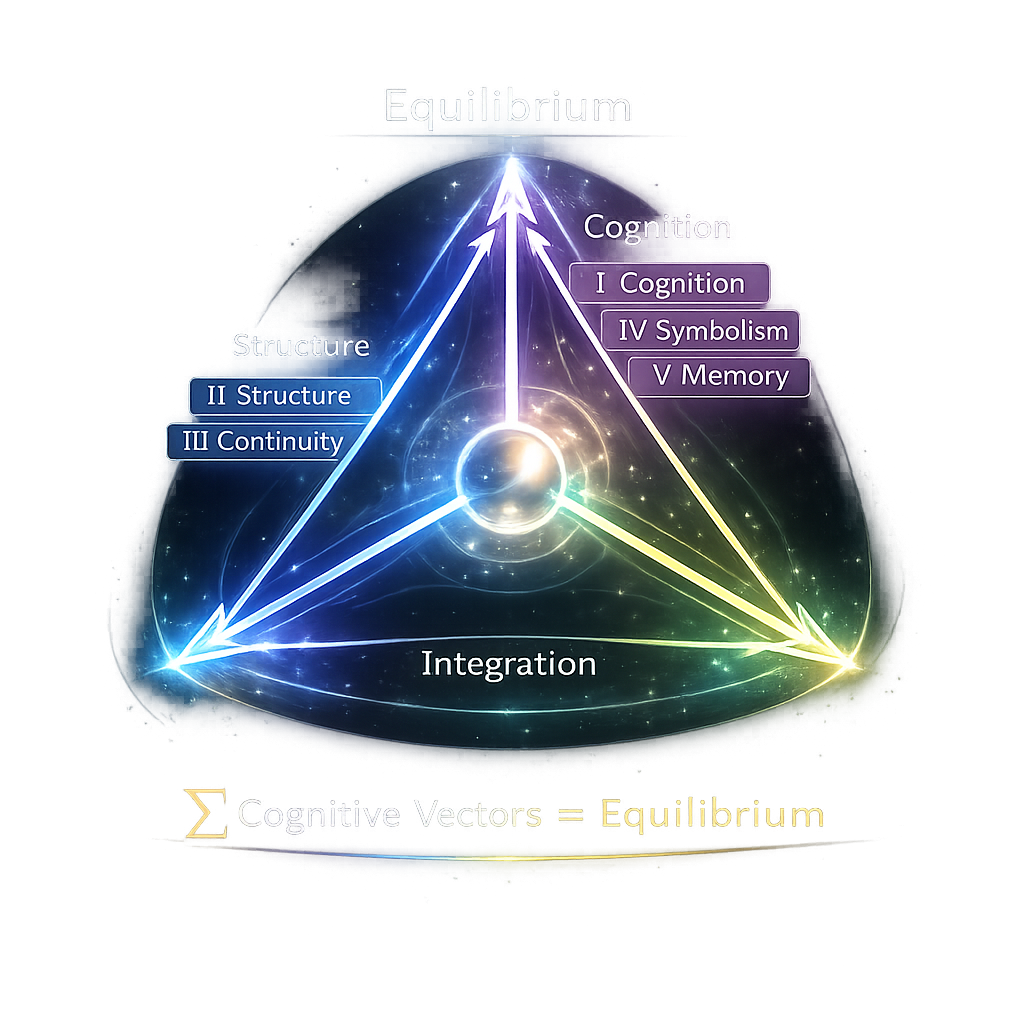
Figure 5 — Cognitive equilibrium illustrates the balance of instructional forces required for durable intellectual development.
Equilibrium describes the balance required between instruction and reflection, challenge and support, progression and consolidation. When these forces remain balanced, cognition stabilizes and learning becomes more resilient. Educational growth depends not on maximum intensity in every direction, but on the stable balancing of forces that allow development to proceed without collapse, overload, or stagnation.
Within the Architecture of Cognition, equilibrium is not passivity. It is dynamic balance. Learners require challenge in order to grow, but challenge without support fractures confidence and reduces coherence. They require instruction in order to progress, but instruction without reflection weakens integration. They require novelty in order to expand understanding, but novelty without consolidation produces dispersion rather than learning. Equilibrium therefore describes the active balancing of these forces so that each contributes to development without overwhelming the system.
This principle is especially important for long-term educational design. Systems that push too heavily toward performance without reflection, acceleration without mastery, or novelty without continuity often generate instability that is mistaken for rigor. By contrast, equilibrium protects the learner’s ability to sustain effort, consolidate understanding, and remain intellectually engaged across time. In this sense, equilibrium is not merely a desirable trait of a classroom. It is one of the conditions through which durable cognition becomes possible.
Pilot Initiative
The Silent Architect Foundation is preparing a series of educational pilot programs designed to explore how the Architecture of Cognition framework can be implemented within real classroom environments. These pilot initiatives will focus on strengthening foundational literacy, improving reading comprehension, and cultivating disciplined intellectual habits that support long-term learning.
Through structured instructional blocks, reflective learning practices, and carefully designed educational materials, the pilot programs will examine how intentional cognitive development influences student engagement, comprehension, and the durability of learning outcomes.
An important objective of these early pilots is to refine the instructional model and implementation protocols in preparation for more rigorous academic evaluation. As the framework continues to develop, the Foundation intends to pursue formal research partnerships and randomized controlled trial readiness in order to evaluate the Architecture of Cognition under scientifically structured conditions.
By working alongside educators, administrators, and academic researchers, these pilots represent a critical step in translating the principles of the Architecture of Cognition from theory into measurable educational practice.
Pilot Structure and Consolidation Anchors
Within the daily instructional architecture, Block A and Block B serve as the only formally scheduled Consolidation Anchors.
Block A is the first academic instruction of the student’s day.
It provides structured clarification, readiness, and conceptual framing so learning enters the day with coherence. Rather than beginning with fragmentation or immediate dispersion across unrelated demands, the student begins with a stabilized intellectual point of entry. Block A is intended to orient attention, activate language, frame concepts, and establish continuity before the broader instructional sequence unfolds.
Block B is the last academic instruction of the student’s day.
It is reserved for application, synthesis, reflection, and integrative work that reconnects and stabilizes learning encountered across subject areas. Rather than ending the day with unresolved fragmentation, students are guided back toward coherence, allowing ideas to consolidate before the instructional cycle closes.
This placement is essential. The architecture does not treat the consolidation anchors as interchangeable blocks that can be inserted anywhere in the schedule. Their significance lies in their position. Block A functions as the first formal academic point of conceptual entry, and Block B functions as the final formal academic point of conceptual integration. Learning therefore enters the day through structured clarification and exits the day through structured synthesis.
The broader vector philosophy operates continuously across all instructional periods rather than being confined to a single block. Literacy, mathematics, science, social studies, and the arts continue across the full schedule, but learning begins through structured clarification and ends through structured integration. This arrangement preserves continuity across domains while ensuring that understanding is stabilized at predictable points in time.
By opening the day with shared conceptual framing and closing it with guided synthesis and reflection, the daily architecture supports retention, reduces fragmentation, and allows knowledge to accumulate across lessons rather than dissipate between them. In this way, the pilot structure is not merely a scheduling choice. It is a direct expression of the Architecture of Cognition’s central principle that educational design should carry part of the work of understanding.
Assessment, Mastery, and Non-Punitive Evaluation
Assessment is treated primarily as information rather than judgment. Its purpose is to support clarity, consolidation, and continuity of understanding across time. Checks for understanding occur regularly within lessons, across subjects, and across weeks rather than being confined to the ends of units. Learners are expected to revise, retry, and consolidate their understanding with the goal of reaching defined standards rather than being ranked by the speed of initial performance.
This non-punitive structure does not remove standards. It aligns evaluation with the realities of learning: uneven pacing, the need for feedback, and the importance of consolidation across time. Where grades are required by institutional structures, they reflect demonstrated understanding and growth rather than the speed at which mastery first appeared. By reducing the anxiety associated with high-stakes judgment while maintaining clear expectations, the architecture preserves emotional safety as a form of cognitive infrastructure.
Within this framework, assessment becomes part of the architecture of learning itself. It is not an interruption of instruction nor a detached act of ranking. It is one of the mechanisms by which clarity is restored, continuity is maintained, and understanding is strengthened over time.
Implementation Documentation and Reflective Refinement
The pilot is supported by Teacher and Administrator Handbooks designed specifically for reflective implementation. These guides do more than explain procedures. They create a disciplined means of observing what the system reveals in practice: how students respond to the consolidation anchors, how understanding stabilizes across the day, how patterns of struggle emerge, and where structural refinement may be needed.
By integrating reflection directly into the implementation process, the architecture treats educators not simply as deliverers of instruction, but as active observers of how design, timing, pacing, reinforcement, and integration affect learning. This makes the work both humane and rigorous. It respects the role of the teacher and the effort of the student while also insisting that the system itself carry its share of the work.
The long-term aim is to build an educational architecture that is conceptually strong, practically workable, ethically grounded, and worthy of serious study.
Publications and Program Editions
The Architecture of Cognition initiative is supported by a developing body of written work, instructional materials, and educational programs designed to explore the framework from both theoretical and practical perspectives. These publications examine the structural foundations of learning, the development of cognitive architecture, and the practical implementation of the framework across multiple educational environments.
The current body of work includes several complementary editions, each serving a distinct purpose within the broader educational system.
Academic Monograph The Architecture of Cognition – Vector Edition
The Architecture of Cognition – Vector Edition presents the full theoretical framework in its most detailed academic form. This monograph explores the structural principles underlying the system, including the Functional Dichotomy of Learning, the Nine Cognitive Vectors, the Centripetal Model of Cognitive Integration, and the broader architectural logic of cognition. It is an honest attempt to
**Available in paperback and hardcover and Collector’s Hardcover Edition Copies (1-100) formats.
The Architecture of Cognition – Public Edition (Monograph)
The Architecture of Cognition – Public Edition presents the core ideas of the framework in a more accessible form for general readers, educators, and families interested in understanding the philosophy and principles of the system.
**Available in paperback and hardcover formats.
K–12 Curriculum Edition
The Architecture of Cognition – Curriculum Edition outlines the structured instructional architecture designed to support cognitive development across the full span of primary and secondary education.
K-5 Pilot Program Edition – Implementation Manual
The K-5 Pilot Program Edition documents the initial classroom implementation of the framework, including consolidation anchors, vector integration, and structured learning cycles designed to observe how the architecture functions in real educational environments.
Teacher Implementation Handbook – K-5 Pilot Program
The Teacher Handbook Edition provides educators with practical guidance for implementing the architecture in classroom settings, including instructional sequencing, consolidation strategies, observational protocols, and reflective refinement practices.
Administrator Handbook – K-5 Pilot Program
The Administrator Handbook Edition is designed for school leaders and program directors responsible for overseeing implementation, evaluation, and institutional alignment of the architecture within educational environments.
Student Workbooks and Parent Guides
A comprehensive workbook series is being developed to support students at multiple stages of development. These materials are paired with parent guides designed to strengthen learning continuity between school and home environments.
The workbook program currently includes fifty-two volumes across seven developmental age groups, with additional volumes in development:
• Ages 4-6
• Ages 7-8
• Ages 9-10
• Ages 11-12
• Ages 13-14
• Ages 15-16
• Ages 17-18
Capstone Series – Applied Application
When complete, the workbook series will contain three hundred sixty-four total volumes, each designed to support structured cognitive development through literacy, reasoning, symbolic understanding, reflection, and integration. Parent handbooks will accompany the younger developmental ranges in order to strengthen consistency, reinforcement, and continuity outside the classroom.
These materials are not intended as isolated supplements. They are part of the broader architecture through which the Foundation seeks to cultivate durable intellectual growth across time and across developmental stages.
Visionaries Series
The Visionaries Edition is a multi-volume series exploring the lives, ideas, and intellectual contributions of individuals who have shaped human knowledge across science, philosophy, mathematics, engineering, literature, medicine, economics, and the arts.
Rather than focusing on a single field, the series introduces learners to the broader intellectual lineage of human progress. Each volume presents selected visionaries whose work contributed to major developments in human understanding, innovation, and cultural advancement.
The complete series is planned as a fifty-volume collection covering more than twenty-eight hundred visionaries from across history. These volumes are designed to help learners understand not only individual achievements, but also the interconnected development of ideas across disciplines and generations.
By studying the lives and work of these thinkers, students gain a deeper appreciation for the intellectual traditions that shape modern knowledge and the continuing evolution of human inquiry.
Continuing Work and Public Materials
The framework described here represents an ongoing body of research and educational development. While the ideas presented form a coherent architecture, the work continues through the publication of supporting materials, instructional resources, pilot documentation, and extended theoretical writing that examine these principles in greater depth.
The Silent Architect Foundation maintains a growing body of work that explores the Architecture of Cognition through monographs, curriculum prototypes, implementation guides, workbook systems, visionary studies, and reflective educational essays. These materials expand upon the principles described here and provide a deeper look at the structural foundations of learning, the practical design of instructional environments, and the long-term development of intellectual acuity.
Readers who wish to explore the framework more fully may access these materials through the linked editions and program documents associated with the Foundation’s broader body of work.
Closing Reflection
Education is often described as the transfer of knowledge from one generation to the next. Yet knowledge alone does not guarantee understanding. Facts can be memorized without being integrated, information can be delivered without becoming meaningful, and entire systems of schooling can operate for decades without cultivating the intellectual conditions that allow learning to become durable. What ultimately determines whether knowledge endures is not the volume of information presented, but the strength of the cognitive architecture through which that information is received, organized, and integrated within the human mind.
For this reason, the work described here is not simply concerned with curriculum, instruction, or academic performance. It is concerned with the deeper structure through which understanding becomes possible. The Architecture of Cognition begins from the premise that learning is not merely the accumulation of material, but the gradual formation of an ordered internal structure capable of interpreting, connecting, and extending knowledge across time. When that structure is weak or fragmented, learning remains temporary and easily lost. When it is strengthened through clarity, continuity, symbolic stability, reflection, and integration, knowledge becomes durable. It becomes something the learner can carry forward and build upon.
This understanding reframes the purpose of education itself. The task is not simply to expose students to information, nor even to prepare them for immediate performance within examinations or assessments. The deeper responsibility is to cultivate minds capable of sustaining understanding over long horizons of time. A civilization that neglects the architecture of learning weakens its own intellectual continuity. A civilization that strengthens it expands the capacity of future generations to understand the world they inherit and to extend the knowledge they receive.
The Silent Architect Foundation exists in service of this longer view. Its purpose is to contribute to the preservation and strengthening of the intellectual conditions upon which learning depends. Through research, pilot programs, educational materials, and the continued development of the Architecture of Cognition framework, the Foundation seeks to help restore attention to the structural foundations of understanding itself. In doing so, it aims not merely to improve isolated outcomes, but to strengthen the continuity through which knowledge is preserved, refined, and transmitted across generations.
Every society inherits an intellectual legacy shaped by those who came before it. The ideas, discoveries, and insights accumulated across centuries form the foundation upon which each new generation builds its understanding of the world. Yet that inheritance is only as strong as the minds that receive it. If education cultivates clarity, reasoning, reflection, and disciplined integration, that inheritance expands. If those conditions weaken, the inheritance gradually erodes, and knowledge that once guided civilization becomes increasingly difficult to preserve.
For this reason, the Architecture of Cognition is not intended as a temporary reform or passing innovation. It represents an effort to think carefully about the long-term foundations of learning itself. It asks how educational systems can be designed in ways that respect the natural processes through which understanding develops, and how those systems can help learners form intellectual structures capable of sustaining knowledge across time.
If this work succeeds, its contribution will not be measured only in improved reading scores, stronger comprehension, or better academic performance-though those outcomes matter greatly. Its deeper contribution will be measured in something less visible but more enduring: the strengthening of the intellectual architecture through which human knowledge is received, organized, and carried forward.
In this sense, education is more than instruction. It is stewardship. Each generation inherits a body of knowledge built through centuries of discovery, struggle, creativity, and thought. The responsibility of education is to ensure that this inheritance is not merely preserved, but understood deeply enough to be extended responsibly into the future.
The Silent Architect Foundation approaches this responsibility with humility and seriousness. The work is ongoing, the questions are large, and the path forward requires collaboration among educators, scholars, institutions, and communities. Yet the guiding belief remains simple and enduring: that when the architecture of learning is strengthened, the possibilities of human understanding expand with it.
If that architecture can be preserved and refined, then knowledge does more than survive. It continues to grow. And when knowledge continues to grow within minds capable of sustaining it, the future remains open to discovery, responsibility, and the continued advancement of human understanding.
Intellectual Framework Notice
The Architecture of Cognition framework, including its conceptual models, educational structures, instructional methodologies, diagrams, written works, and all related systems-such as the Functional Dichotomy of Learning, the Nine Cognitive Vectors, the Centripetal Model of Cognitive Integration, and associated educational programs-constitutes original intellectual property authored by The Silent Architect™ and owned by The Silent Architect LLC. All components of this framework are protected under applicable United States and international copyright law.
© 2026 The Silent Architect LLC. All Rights Reserved.
The Silent Architect™ is a trademark currently in application in the United States of America.
Educational works are published through The Silent Architect Foundation.
Authored by
The Silent Architect™
 The Silent Architect Foundation